
1971
In 1971, a small but determined group of 11 paramedical technical and professional employees from the Misericordia Hospital believed that their training, certification, and professional ethics suggested they had a unique community of interest with other health-care workers and they decided to establish an independent union that would be subject to their control and direction.
Of these 11 employees, George C. Hall, an X-Ray Technician at the Misericordia Hospital, was instrumental in the formation of HSAA and became its first Executive Director, serving in that role for over a decade.
On December 15, Remedial gymnast Mr. Robert Law – a member of the working committee – motions to name the organization The Health Sciences Association of Alberta (HSAA).
HSAA in the 70s
1972: HSAA’s first constitution is prepared and signed by laboratory technologists, X-ray technicians, medical records keepers, respiratory therapists, and remedial gymnasts.
March 22, 1972: HSAA officially registers as an organization under the Societies Act, 1970.
April 17, 1972: HSAA holds its first Annual General Meeting.
November 28, 1972: In the landmark Labour Relations Board decision Health Sciences Association of Alberta v. Misericordia Hospital (Alta. L.R.B. No. 72-024), HSAA is certified to represent paramedical and technical employees at Edmonton's Misericordia Hospital. This ruling establishes HSAA's first bargaining unit and marks the beginning of the union's growth across Alberta.
1974: HSAA successfully organizes and certifies workers at the Canadian Red Cross, marking the union's first non-hospital bargaining unit certification.
1975: HSAA successfully organizes and certifies workers at Calgary Medical Laboratories, establishing the first private, for-profit employer unit.
1977: The Board of Industrial Relations formalizes standard hospital industry bargaining units. This decision by the Government of Alberta caps and standardizes health-care labour into five specific functional units.
HSAA in the 80s
July 23, 1981: HSAA becomes certified to represent a combined technical and professional unit at the Workers' Compensation Board (WCB) Rehabilitation Centre, with the first collective agreement signed on this same day.
1982: Propelled by public outreach—including HSAA television spots aired in Edmonton and Calgary—membership grows to 3,000.
1984: HSAA establishes the Members' Educational Fund and the Members' Assistance Fund to provide direct financial support to members and their families.
1985: Membership continues to climb, growing to over 4,000.
1986: The Members' Educational Fund increases its allocation from $150 to $200 per fiscal year for applicants.
1988: The Members' Educational Fund increases further to $300 per fiscal year for applicants.
HSAA in the 90s
January 21, 1991: HSAA receives its first health unit certification, representing employees of the Edmonton Board of Health.
August 1992: HSAA launches its first newsletter to keep members informed and connected as the union grows; it is subsequently renamed The Challenger in December.
1993: HSAA and other unions help organize the Common Front—a grassroots coalition to share concerns regarding government cuts to education, health, and social programs. HSAA also participates in the Provincial Roundtable on the Alberta provincial budget.
1994: HSAA, alongside other healthcare unions, successfully lobbies the government to contribute $15 million toward workforce adjustment.
November 22, 1995: Approximately 200 HSAA members at the Bow Valley Centre and Foothills walk out in support of striking laundry workers.
November 30, 1995: HSAA-represented home support workers in the Barons-Eureka-Warner and Chinook Health Units go on strike and successfully defend their jobs.
1998: HSAA prevents the introduction of the Health Statutes Amendment Act (Bill 37, 1998), which sought to incorporate privatized surgical clinics in Alberta.
HSAA in the 2000s
Spring 2000: HSAA and its members rally against the introduction of the Health Care Protection Act (Bill 11, 2000).
2002: HSAA presents at the first informative meeting of the Canadian Health Professionals Secretariat.
2003: HSAA expands its influence by joining the National Union of Public and General Employees (NUPGE) and the broader house of labour, affiliating with the CLC, AFL, and District Labour Councils, while also becoming active in Public Interest Alberta.
2004: HSAA provides assistance to the Newfoundland and Labrador Association of Public and Private Employees (NAPE) to support their struggle for a new collective agreement.
2005: Several HSAA members are elected to leadership positions in multiple District Labour Councils, and HSAA joins the Fort McMurray Labour Council.
2006: Widespread opposition from HSAA, labor organizations, health-care advocates, and Albertans contributes to the defeat of the "Third Way for Healthcare in Alberta" proposal.
2007: HSAA’s Board doubles the number of bursaries for members and members' spouses/dependents to 80 part-time and 100 George C. Hall bursaries (previously 40 and 50, respectively).
2008: HSAA holds its first-ever EMS conference in Leduc and welcomes over 800 DynaLIFE Dx employees, several more from non-unionized sites, and multiple EMS units. The Government of Alberta also announces the creation of the Alberta Health Services Board.
HSAA in the 2010s
2010: HSAA's membership grows significantly with the integration of 1,500 EMS and AADAC employees, while the union conducts its first successful online bargaining survey.
2012: Alberta passes Bill 1, Workers' Compensation Act, (RSA 2000, c W-15), establishing post-traumatic stress disorder (PTSD) as a presumed work-related injury for emergency workers.
2013: HSAA launches a brand-new website and engages members through community initiatives like the "Green Our Healthcare" challenge.
2014: Members brave extreme cold to protest pension cuts, and HSAA vigorously fights back against damaging anti-union legislation such as Bills 45 and 46.
2015: HSAA launches the "Caring Hands" public awareness campaign and support Alberta Nurses against job cuts.
2016: Premier Rachel Notley addresses Convention delegates—marking a first in HSAA history. HSAA also creates the Member Resource Centre.
2017: HSAA successfully wins a landmark lawsuit against the Alberta paramedic college, secures a new Calgary office, and welcomes a sponsored Syrian refugee family.
2018: Intensive lobbying by HSAA secures a $29-million funding boost to reverse ambulance service cuts.
HSAA in the 2020s
2020: Navigating the overwhelming challenges of the early COVID-19 pandemic, HSAA launches a massive peer-support initiative, with volunteers making over 7,600 calls and texts to check in on frontline members.
2021: Despite government-proposed wage rollbacks of up to 10%, HSAA successfully ratifies a collective agreement with AHS for approximately 20,000 members, securing zero wage decreases and an across-the-board wage hike.
2022: Following the controversial privatization of community lab services to DynaLIFE, HSAA wins a major victory at the Alberta Labour Relations Board, protecting vital benefits like the Local Authorities Pension Plan for over 2,000 members.
2023: The Government of Alberta announces plans to restructure AHS into four new streamlined agencies in an effort to reduce hospital and laboratory wait times.
2024: HSAA collaborates with the Government of Alberta to develop and expand the Rural Capacity Investment Fund, addressing critical recruitment and retention challenges across rural healthcare.
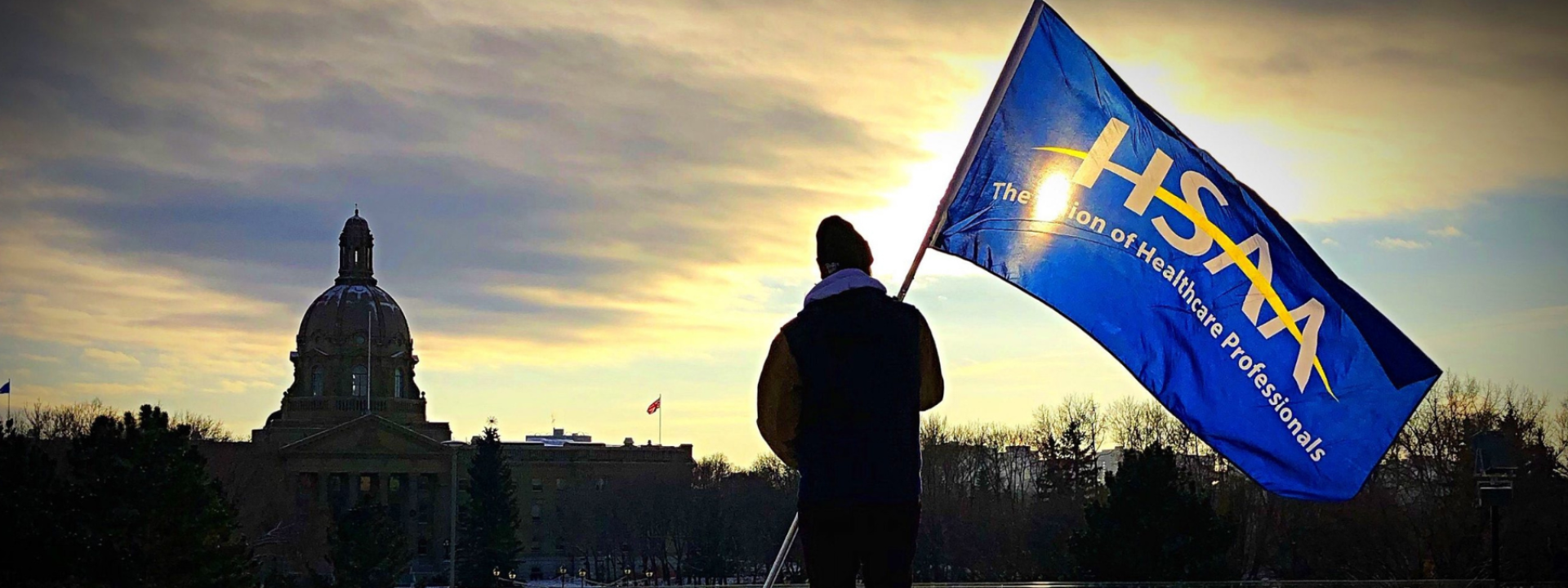
2025: HSAA unites with major labour organizations for the “Rally for Respect” at the legislature on October 24th to unite for a call for respect and fairness to union members.
HSAA Currently
From its beginnings as a small organization founded by 11 health professionals in 1971, HSAA has grown into one of Alberta's leading health-care unions, representing more than 30,000 members across over 240 professions and 226 local units. Through periods of growth, restructuring, economic uncertainty, labour disputes, and a global pandemic, HSAA members have remained at the forefront of patient care. As Alberta’s healthcare system changes and innovates, HSAA will continue the fight for our members to ensure the collective voice of our members is heard, valued, and respected.
Quick Hits of the 70s
Quick Hits of the 80s
Hits of the 90s
Hits of the 2000s
Hits of the 2010s
Current Hits